City life
Convenience is the real wellness luxury.
The best routine is rarely the most impressive one. It is the one close enough to survive a rainy Tuesday and a late meeting.
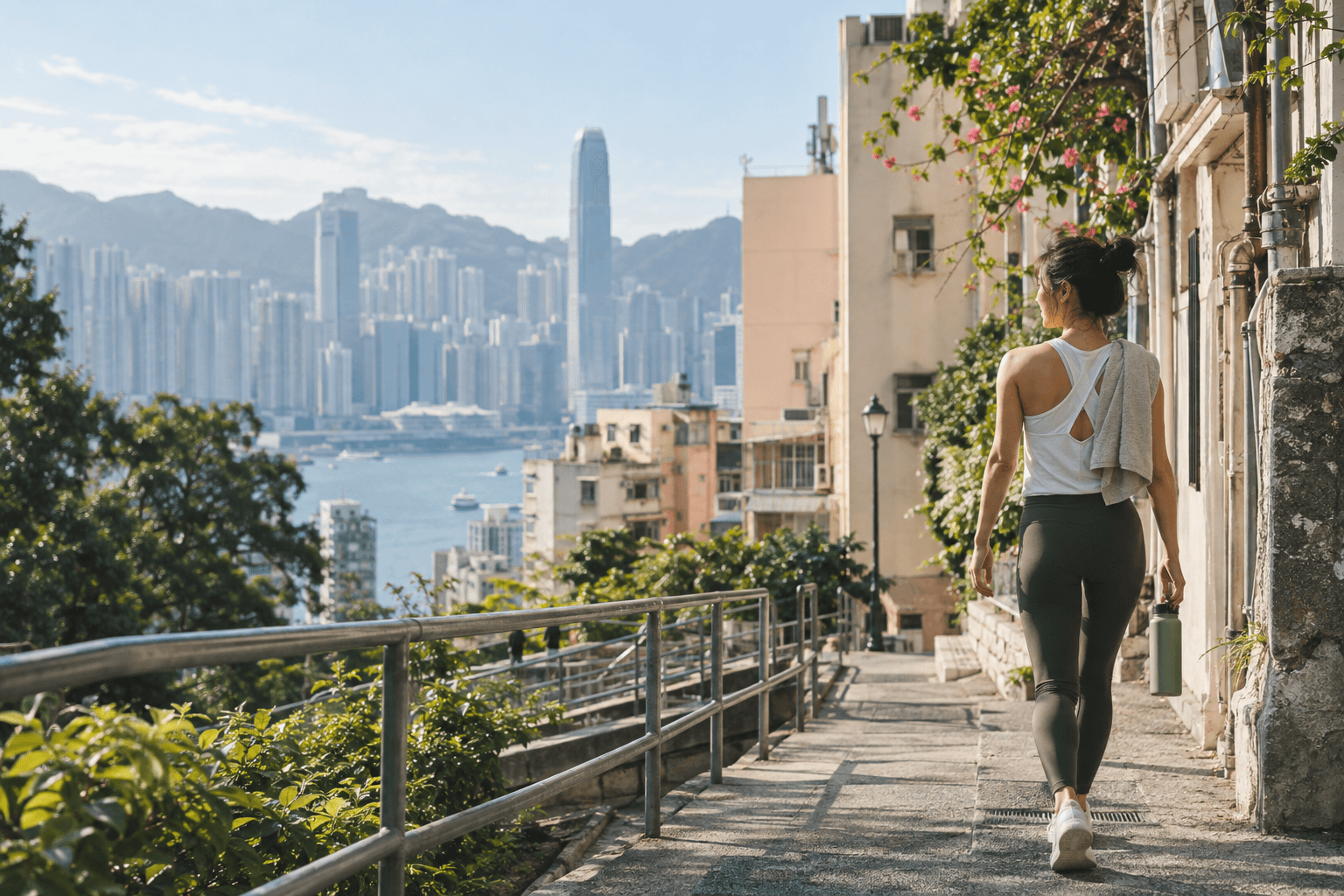
Wellness is often marketed as escape: a retreat, a transformation, a version of life with more time than the one we actually have. Hong Kong makes that fantasy especially tempting. It also makes it especially impractical.
A pool beside your MTR stop can matter more than a beautiful club across town. A decent lunch downstairs can do more for your week than a perfect meal plan that requires three shops and a Sunday afternoon. Proximity is not laziness. It is design.
Build for the week you actually have
We should judge a habit by how little negotiation it demands. If getting there needs two interchanges, special clothes and an hour of mental preparation, it is an occasional experience—not a routine. There is nothing wrong with that, but it helps to name it honestly.
The quiet advantage of a local directory is not abundance. It is subtraction. Find the three places that fit your route, your budget and your energy. Then let repetition do the work.
Friction decides more than motivation
The wellness industry likes motivation because motivation can be sold back to us: a challenge, a new identity, a dramatic before-and-after. Daily behaviour is less cinematic. It is shaped by the minutes between leaving work and arriving somewhere, whether a lift is crowded, whether a class requires booking days ahead, and whether dinner still needs to be made afterwards. These details look trivial until they repeat fifty times. Then they become the routine itself.
Hong Kong is unusually good at compressing life. A sports centre can sit above a wet market; a yoga room can be three floors from an office; a trail can begin behind a housing estate. Yet we often ignore this advantage while chasing an ideal routine imported from places with spare rooms, cars and spacious weekends. Local wellness should begin with the city as it is: dense, vertical, fast, humid and full of useful things hidden upstairs.
Design three versions of the habit
A durable routine has more than one setting. There is the full version for a good Saturday: a class, a shower, perhaps lunch nearby. There is the weekday version that fits between work and home. And there should be a minimum version for the week that goes wrong: twenty minutes in the nearest pool, a walk around the block, or a meal assembled from the healthy shop downstairs. The minimum is not failure. It is the bridge that keeps a practice familiar.
This is also why locality matters more than a single citywide ranking. The best gym in Hong Kong may be irrelevant to someone who crosses the harbour in the opposite direction. A modest studio on the route home may create hundreds of useful visits. Quality still matters, but quality includes access, timetable, welcome, price and the likelihood that you can return without reorganising your life around it.
A more generous definition of luxury
Luxury is usually described through rarity: the private room, the imported treatment, the view nobody else can access. For everyday wellbeing, repetition is more valuable. The luxurious thing is a place that remembers your name, a court you can afford every week, opening hours that acknowledge shift work, or a nourishing dinner that does not require a reservation. Reliability is less photogenic than exclusivity, but it is far more capable of changing a life.
So begin with a map, not a fantasy. Mark home, work and the stations you already use. Look for one place to move, one place to eat well and one place to slow down inside that ordinary geography. Try them at the inconvenient time, not only on a perfect day. If they still work, you have found something better than an aspirational destination. You have found infrastructure for the life you already live.
The seven-day test
Before buying a long membership, test a venue against one real week. Visit after the meeting that usually runs late. Try the route in rain. Notice whether you can carry the necessary kit, find a sensible meal nearby and still arrive home at a humane hour. Ask what happens when a class is full or you need to cancel. A glossy tour shows the venue at its best; a weekday test shows whether it can belong to your life. The answer may be a less spectacular place five minutes away, and that is useful information rather than a compromise.
Then remove one obstacle rather than reinventing your personality. Keep a spare shirt at work. Save two nearby options instead of one. Choose a recurring slot that is merely good, not theoretically perfect. Pair the visit with something already fixed, such as school pickup, a commute or grocery shopping. These adjustments are almost embarrassingly ordinary. That is their strength. Sustainable wellbeing is usually assembled from small pieces of cooperation between a person and their environment, not summoned by an extraordinary act of will.
This article expresses an editorial point of view and is for general information only. It is not medical advice.